Interest Rates, Buying Power, and Why New Construction Does Better Math
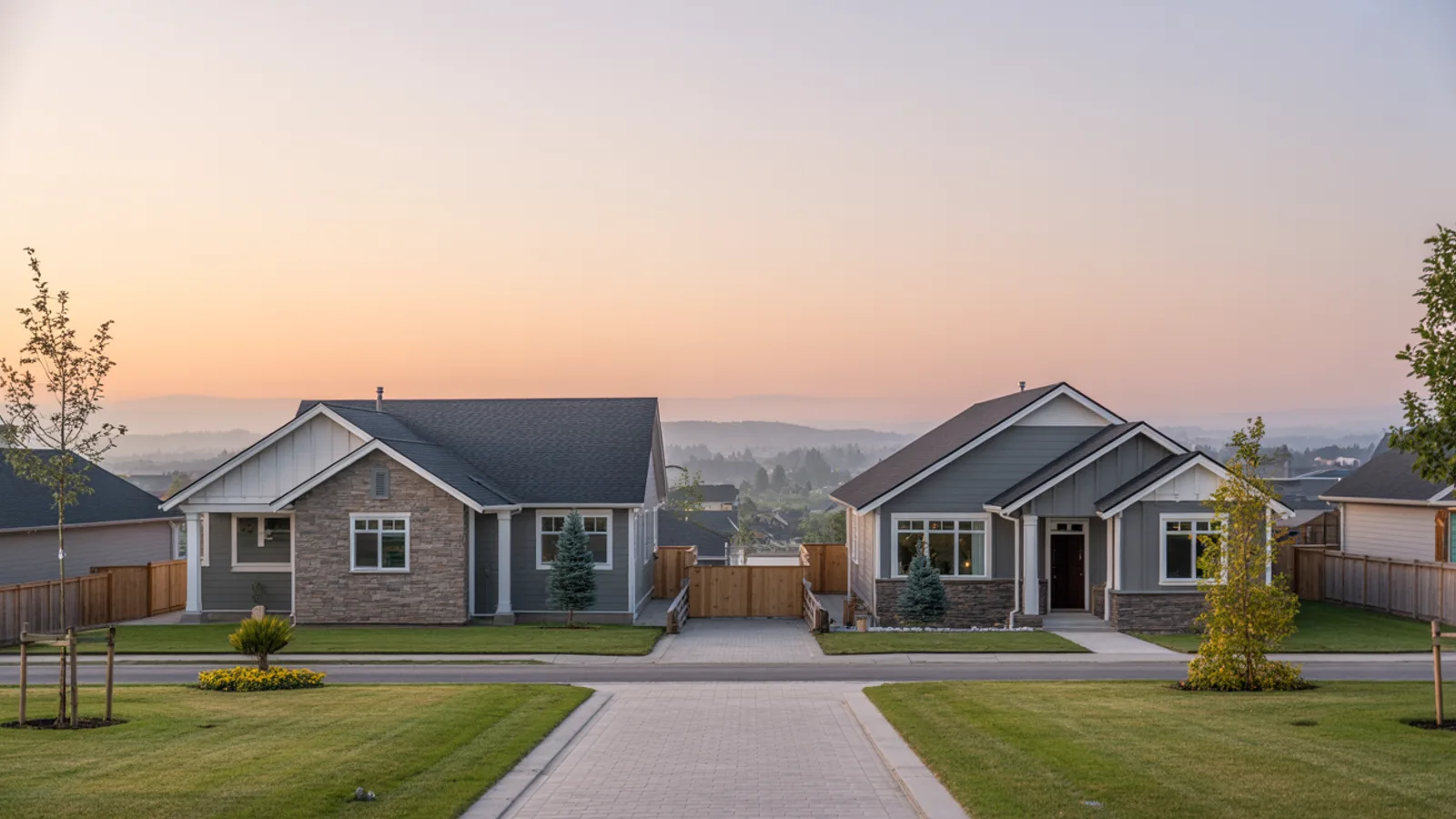
Most Portland buyers I talk to are stuck on a sticker price. They picked a budget twelve months ago and think the only number that moved is the home price. The rate moved too, and rates do more damage to your purchasing power than headlines do.
Here is what is actually happening in 2026, and where new construction quietly fixes most of the math.
The rate-to-buying-power tradeoff
The 30 year fixed mortgage rate published by Freddie Mac is the right number to track. Every Thursday they update the Primary Mortgage Market Survey at freddiemac.com/pmms. The Federal Reserve Bank of St. Louis hosts the same series at FRED MORTGAGE30US if you want the long history.
The shortcut every loan officer learns on day one: a one percentage point change in the rate moves your buying power by roughly ten percent at the same monthly payment. The math is mechanical. At 6% on a 30 year amortization, $3,000 a month in principal and interest finances about $500,000. At 7% the same payment finances about $451,000. That is a $49,000 swing on the same paycheck.
Three honest takeaways from the rate side:
- You buy the rate, not the price. Refinancing later is real but uncertain. Lock in the affordability today.
- Builders move on rates faster than sellers move on price. A resale seller has to cut $25,000 off list to match what a $15,000 builder rate buy-down does for your monthly payment.
- Watch points, not just rate. The advertised rate is often quoted with discount points baked in. Ask for the par rate, the rate after points, and the seller-paid concessions in writing.
Builder rate buy-downs are the underused lever
This is where new construction quietly wins the financial comparison in 2026. Production builders, including the LGI communities I work in, are using their balance sheet to absorb the rate gap. The two common structures:
- Permanent rate buy-down. The builder pays discount points at closing to permanently lower your interest rate for the entire 30 year loan. Cleanest version. Works at any income level.
- 2-1 temporary buy-down. Year one is two points lower, year two is one point lower, year three onward is the note rate. Useful if your income is rising. Less useful if it is not.
The cumulative effect on a $450,000 loan, with even a half-point permanent buy-down, is tens of thousands of dollars over the life of the loan. None of those dollars come out of your pocket. A resale seller almost never matches that with a price cut, because their equity is finite and their motivation to close is different.
Capital expenditure: the line buyers forget to draw
Sticker price is not the cost of the house. The cost of the house is sticker price plus everything you have to put back into it over the next ten years. This is your capital expenditure exposure, what landlords call CapEx.
A 1995 resale at $480,000 in the Portland metro looks like a deal next to a $510,000 new build. Then the inspection comes back. Realistic ten year reserve numbers from the Portland market:
- Roof replacement on a 25 year old composition shingle: $14,000 to $22,000.
- HVAC system replacement (furnace plus AC, properly sized): $9,000 to $16,000.
- Water heater replacement (40 to 50 gallon, gas or electric): $1,800 to $3,500. Heat pump unit, more.
- Electrical panel upgrade if the existing panel is undersized for modern loads (heat pumps, EV charging): $3,500 to $7,500.
- Exterior paint and trim, every 8 to 12 years in the Pacific Northwest: $6,000 to $12,000.
- Window replacement when single pane or failed dual pane shows up: $14,000 to $30,000 for a typical home.
That is $48,000 to $91,000 of expected outflow over a ten year hold on a 1995 home, before any aesthetic updates. Some of it can be deferred. Most of it cannot. Insurance carriers price the risk into your premium, which leads directly to the next section.
New construction insurance is materially cheaper
The insurance industry tracks losses by home age and the data is clear. Newer homes file fewer claims, smaller claims, and present lower fire, water, and electrical risk. The Insurance Information Institute publishes the underlying data at iii.org/publications/facts-statistics-homeowners-and-renters-insurance.
The premium difference shows up at quote time. In the Portland metro, a typical 2,000 square foot new build at $500,000 replacement cost lands somewhere around $900 to $1,400 per year on standard HO-3 coverage with a major carrier. A 1985 home at the same coverage limits routinely quotes $1,600 to $2,400. The drivers behind the gap:
- Modern wiring (no aluminum branch circuits, no cloth-covered originals).
- Modern plumbing (no polybutylene, no original galvanized supply lines).
- Newer roof age, which insurers credit aggressively.
- Hardwired smoke and CO detection wired to a panel.
- Modern electrical service with arc fault and ground fault protection at the panel.
Over a ten year hold, the insurance premium gap alone is often $7,000 to $10,000 in your favor on a new build, before you factor in the avoided claim deductibles and the avoided rate-shock when carriers reprice an aging home after a regional loss event.
Stacking the math
For a typical Portland metro buyer in 2026 comparing a $480,000 resale (1995 build) and a $510,000 new build at the same monthly payment range, the ten year picture honestly looks like this:
- Builder rate buy-down advantage on the new build: $25,000 to $45,000 in present value.
- Avoided CapEx on the new build over ten years: $35,000 to $70,000.
- Lower insurance premium over ten years: $7,000 to $10,000.
- Lower utility cost from modern envelope and HVAC: $4,000 to $9,000 (covered in more detail in the Pacific Northwest quality of life post).
The new build is not just better, it is structurally cheaper to own. A $30,000 sticker premium gets paid back several times over inside the first decade.
Where Dove Landing fits
If this math interests you, the Dove Landing community by LGI Homes in Portland is a good place to walk through it in person. Floor plans, current builder incentives, rate buy-down programs, and the warranty package are all on the LGI page at lgihomes.com/oregon/portland/dove-landing.
If you want a second opinion before you commit to a builder, a community, or a rate-lock, that is what I am here for. I am an Oregon and Washington licensed REALTOR and I work in new construction at LGI. I can tour you through Dove Landing, run the rate-to-payment math against your specific income and credit profile, and walk you through the warranty package side by side with a resale alternative. No pressure, no obligation, just the math you actually need to make the decision.
Sources: Freddie Mac PMMS (freddiemac.com/pmms), FRED MORTGAGE30US (fred.stlouisfed.org/series/MORTGAGE30US), Insurance Information Institute homeowners statistics (iii.org). All dollar figures are illustrative ranges for the Portland metro as of mid-2026. Verify current rates, premiums, and builder incentives before relying on them.
Have Questions?
I’m always happy to chat about real estate in Oregon. No pressure, no commitment.